

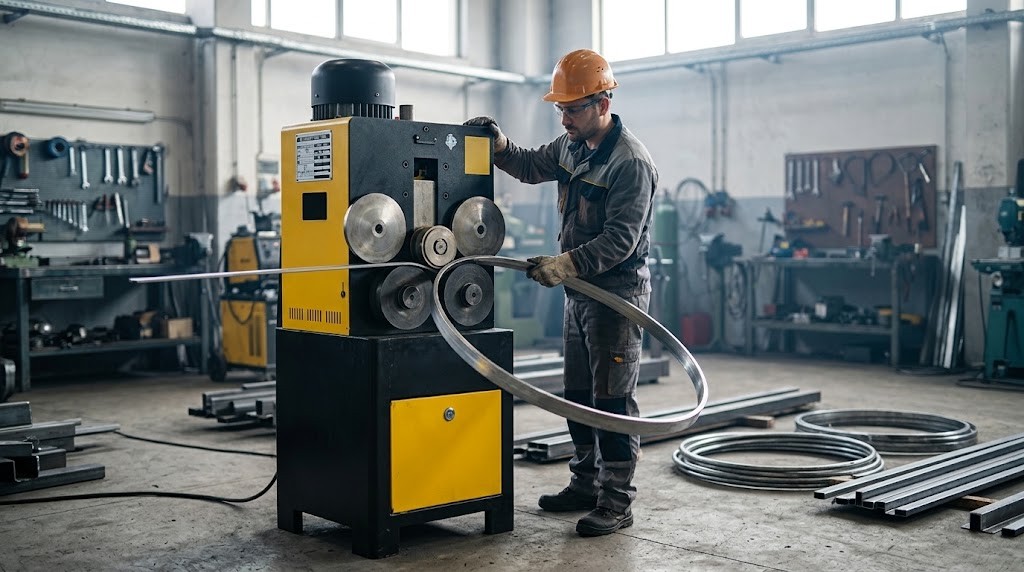
When evaluating hoop bending machine options with bending capacity tailored to your project, the properties of the material to be processed, the target hoop diameter, production volume and work area should be considered together. The right machine is not chosen solely by looking at the largest material diameter that can be bent. The size of the part to be produced and the daily workflow of the business also directly affect the purchasing decision.
The following criteria stand out when choosing a hoop bending machine:
Type, cross-section and mechanical properties of the material to be processed.
Target hoop diameter and bending radius.
Daily production volume and frequency of switching between sizes.
Setup, control and operator usage requirements.
Installation, feeding and maintenance conditions of the machine.
When discussing your machine request with Göçmenler Group, you can share your technical drawings, material information and production expectations. This way, you can evaluate options not only by catalog capacity but by the working conditions your project requires. Specifying regularly produced parts together with periodic orders helps define the required capacity range more accurately.
The capacity of a hoop bending machine is a technical selection criterion that should be evaluated together with the properties of the material to be processed and the desired bending size. Different strength properties at the same material diameter can affect the machine's suitability. Therefore, it should be checked for which material conditions the capacity information is given.
Rather than focusing only on the current order during selection, the scope of regular production should also be determined. Separating the sizes the business uses frequently from those it rarely needs helps avoid unnecessary capacity choices.
It is also important whether the hoop size in the project drawing is specified as the inner diameter, outer diameter or centerline diameter. Clarifying the dimension definition at the outset ensures that the requested part and the evaluated machine capacity are considered within the same technical framework.
Machine options should be compared according to the variety of parts to be produced and the work routine. Repetitive production in a single size and small batches prepared in different diameters do not have the same usage priorities.
| Evaluation area | Information to clarify in the project | Contribution to selection |
| Material properties | Type, cross-section, diameter and strength data | Evaluating capacity suitability |
| Hoop size | Target diameter and accepted dimensional tolerance | Checking bending limits |
| Production volume | Daily quantity and batch size | Defining the work routine |
| Size changes | Frequency of switching to different parts | Comparing setup requirements |
| Work area | Feeding, outfeed and installation clearances | Suitability for in-house use |
Along with production volume, the frequency of size changes is a factor that affects operating efficiency in hoop bending machine selection and should be evaluated separately. For frequently changing orders the setup process comes to the fore, while for repetitive jobs maintaining the same size may be more decisive.
By sending your sample part drawing to Göçmenler Group, you can request that machine options be evaluated together with your production routine.
Clearly defining the target size in hoop production makes machine evaluation easier. Requests for a full hoop, an open-ended circular part or a specific arc shape should be distinguished from one another. It should not be assumed that every model can produce all of these shapes.
If the part will undergo welding, assembly or another process after bending, this should also be stated in the request. The end geometry and joining requirements needed for the next process can affect the acceptable part shape.
Sample part evaluation helps understand not only that the machine can bend, but under which working conditions it can achieve the requested geometry. If possible, the evaluation should be carried out on the material that will be used in actual production. A sample obtained with a different material should not be assumed to give the same result for all orders.
The space allocated for a hoop bending machine requires a broader evaluation than the machine's external dimensions. The space required to bring the material to the machine, for it to move during bending and for removing the finished part should be planned in advance.
In jobs where long materials are fed or large-diameter parts are produced, the position of surrounding equipment should be examined separately. The operator's access to controls, access to maintenance points and the material stacking layout should also be included in the installation decision.
Planning the machine installation together with material flow helps reduce unnecessary handling during production and circulation problems in the work area. Power supply, installation requirements and operating instructions should be verified through the technical documents of the model being evaluated. The equipment included in delivery and the components that must be supplied separately should be clarified before purchase.
Sharing the following information when preparing your hoop bending machine request makes it easier to compare options:
When evaluating a quote, the capacity table, scope of use and any additional equipment should be reviewed along with the model name. By discussing hoop bending machine options with bending capacity tailored to your project with Göçmenler Group, you can request information about alternatives suited to your production needs.